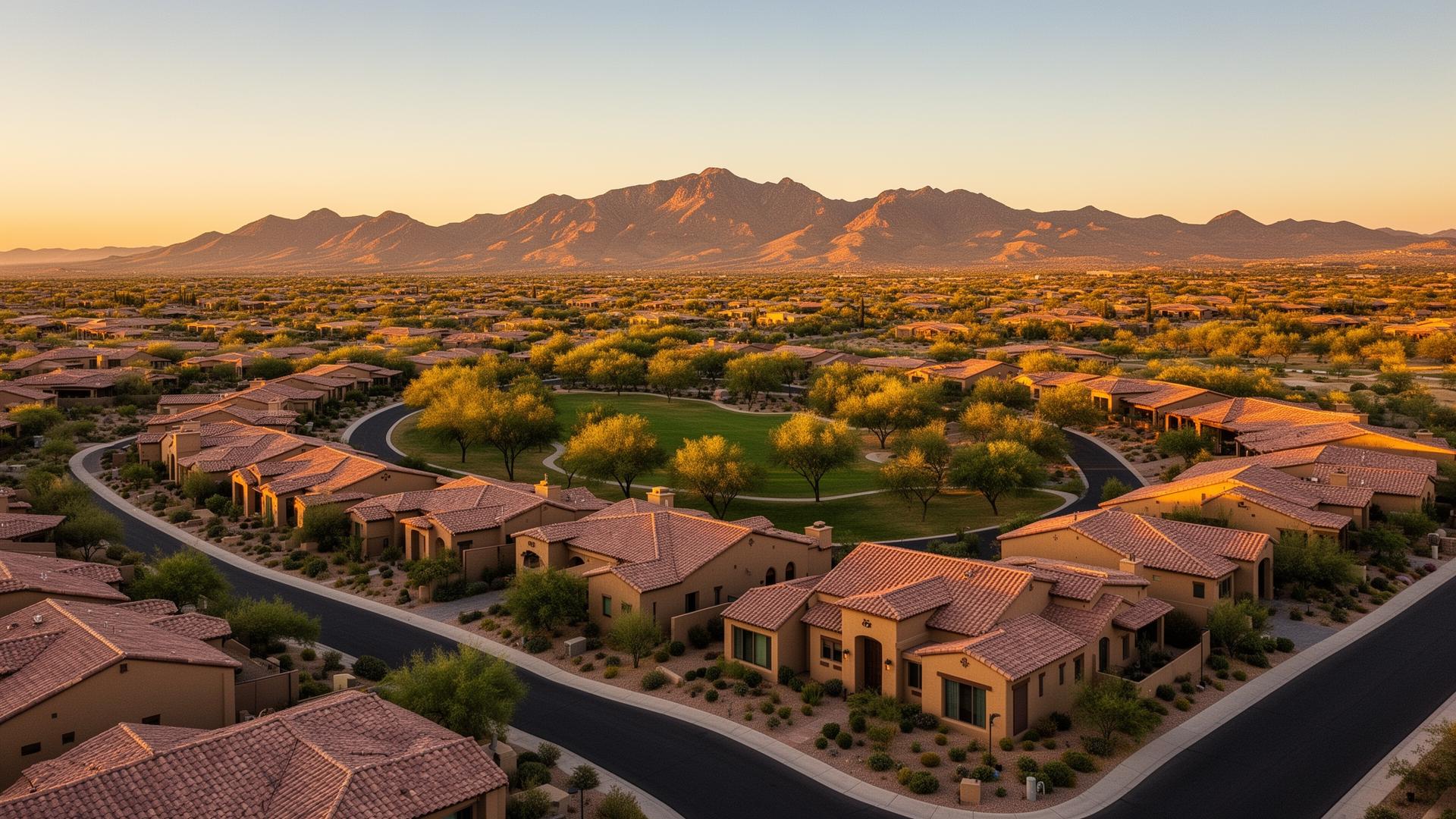
Queen Creek vs San Tan Valley: Which Is Better for You in 2026?
Trying to decide between Queen Creek and San Tan Valley? This breakdown focuses on what actually changes your day-to-day life: budget, commute, schools, and feel.
Key Takeaways
- 1Queen Creek trades higher prices for stronger amenity access
- 2San Tan Valley maximizes space and budget with longer drives
- 3New builds and golf communities exist in both, but in different pockets
Quick Answer
Queen Creek and San Tan Valley are often grouped together because they share zip codes, school boundaries, and grocery runs — but they are not the same product. Queen Creek is an incorporated town in Maricopa County with a planned town center, parks system, and stricter design standards. San Tan Valley is an unincorporated census-designated place in Pinal County, governed at the county level, with newer subdivisions, larger lots, and prices that typically run $40K–$80K lower for a comparable floor plan. The differences show up most in price per square foot, commute exposure, HOA structure, and how finished the surrounding area feels.
This article is a side-by-side comparison. If you're trying to actually decide between the two, see our companion guide: Queen Creek vs San Tan Valley — Which Is Better.
Trying to decide between Queen Creek and San Tan Valley?
Side-by-Side Comparison
| Attribute | Queen Creek | San Tan Valley |
|---|---|---|
| Government | Incorporated town (Maricopa County) | Unincorporated (Pinal County) |
| Median home price | ~$520K | ~$420K |
| Typical lot size | 6,000–10,000 sq ft | 7,000–12,000 sq ft |
| Dominant home age | Mix of 2005–2024 | Mostly 2015–2025 |
| New construction share | Moderate, infill heavy | High, large active subdivisions |
| School districts | QCUSD, mostly | FUSD, JOUSD, QCUSD (varies by street) |
| Town center | Yes — Queen Creek Marketplace, Olive Mill | None — retail clustered along Hunt Hwy |
| Property tax rate | ~0.62% | ~0.68% |
| HOA prevalence | Very high | Very high |
| Commute to Phoenix Sky Harbor | ~45–55 min | ~55–70 min |
Key Differences
Price and Square Footage
The clearest gap is price. A 2,400 sq ft, 4-bed home built in 2020 typically lists in the high $400Ks to low $500Ks in San Tan Valley and the mid-$500Ks to low $600Ks in Queen Creek. Buyers cross-shopping the two often find they can get an extra 200–400 sq ft, a three-car garage, or a larger lot for the same budget by moving south of Hunt Highway.
Property taxes are slightly higher in Pinal County, which narrows the monthly-payment gap a little — but not enough to erase it.
Lifestyle and Built Environment
Queen Creek has spent the last decade building a recognizable town identity: the Queen Creek Marketplace, Schnepf Farms, the Olive Mill, a growing downtown core, and a connected park and trail system. Restaurants, gyms, and medical offices are inside the town, not a drive away.
San Tan Valley is still maturing. Daily retail (Fry's, Walmart, Target, Costco at Queen Creek border) is reachable, but most of it is clustered along Hunt Highway and Ironwood, not woven into neighborhoods. The trade-off is space and quiet — many San Tan Valley subdivisions back to open desert or agricultural land that Queen Creek has already absorbed.
Commute
Both areas commute via the same arteries: Ellsworth/Meridian north to the Loop 202, or Hunt Highway west to the I-10. From Queen Creek, you're typically 5–10 minutes closer to the 202 on-ramp at Elliot. From San Tan Valley — particularly the Johnson Ranch, Skyline Ranch, and Magic Ranch areas — Hunt Highway adds real time during 7–9 AM and 4–6 PM. A 45-minute Sky Harbor drive at noon can become a 75-minute drive at 5:15 PM.
If your job is in Chandler, Gilbert, or the Loop 202 tech corridor (Intel, Northrop, ASU Polytechnic), the commute difference is small. If your job is in central Phoenix, Scottsdale, or the West Valley, it compounds.
Home Styles
Queen Creek's housing stock is more varied because it's older. You'll find late-2000s semi-custom homes on quarter-acre lots, golf-course frontage in Encanterra and Trilogy, equestrian properties east of Sossaman, and brand-new infill from Toll Brothers, Tri Pointe, and Ashton Woods.
San Tan Valley is more uniform: large production-builder communities (Lennar, Meritage, Richmond American, D.R. Horton, KB) with consistent floor plan menus, single-story prevalence, and 2015-or-newer construction. If you want a turn-key new build with a builder warranty, your inventory is deeper here. If you want character, age variety, or a custom lot, Queen Creek has more.
What Surprises Buyers
- The border is invisible on a map but real on paper. The same street can flip from Queen Creek (Maricopa) to San Tan Valley (Pinal) at an intersection — changing your county, taxing authority, school district, and sometimes your insurance quote.
- HOAs are nearly universal in both. Buyers expecting "rural Pinal" freedoms (RVs in driveways, casitas, livestock) are often surprised that San Tan Valley HOAs are just as restrictive as Queen Creek's.
- School district isn't determined by city name. A San Tan Valley address can sit in Florence Unified, J.O. Combs, or Queen Creek Unified depending on the subdivision. Always verify by address, not zip code.
- Resale timelines differ. Queen Creek resale tends to move faster in slower markets because buyers recognize the town brand. San Tan Valley resale often competes directly with builder incentives next door, which can extend days-on-market.
- "New" doesn't always mean San Tan Valley. Queen Creek still has active new-construction phases, especially east of Meridian and north of Ocotillo — the assumption that all new builds are in STV is outdated.
Final Thoughts
Queen Creek and San Tan Valley aren't competitors so much as two stages of the same growth curve. Queen Creek shows you what San Tan Valley may look like in 8–12 years: more retail, more infrastructure, higher prices, and a more defined identity. San Tan Valley shows you what Queen Creek looked like in 2012: more inventory, more land, lower entry points, and more variability between subdivisions.
The right side of the line depends less on which area is "better" and more on what you're optimizing for — square footage, commute minutes, school assignment, builder selection, or neighborhood maturity. Pull the same floor plan from a builder in both areas, compare the lot, the commute, and the school assignment side by side, and the differences become concrete instead of theoretical.
For an opinion-driven walkthrough of which one fits which buyer, see Queen Creek vs San Tan Valley — Which Is Better.
Common Questions